L'Interdit Eau de Parfum by Givenchy | Editorial Review

Add your review

Built on the contrast between creamy white flowers and a dark woody base, L'Interdit stands out for holding that duality without ever fully resolving it, offering a modern femininity that blends floral sweetness with an earthy, long-lasting character.

Brand:

Classification: Floral, Floral Fruity, Floral Woody
Sillage: Strong ●●●○
Longevity: Long-Lasting ●●●●○

WHAT DOES L'INTERDIT EAU DE PARFUM SMELL LIKE?

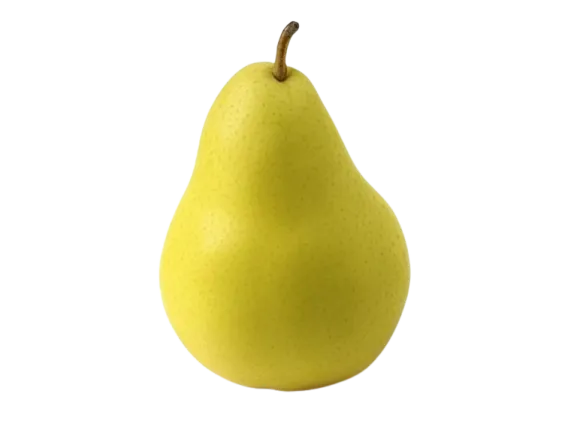
L'Interdit opens with a contrast in temperature: a bright, slightly spicy citrus flash reminiscent of fresh fruit peel brushed with a touch of warm spice. Almost immediately, a lusciously fruity sweetness emerges, evoking ripe pear and even bubblegum or fruit candy, giving the opening a fresh yet juicy feel from the very first moment.

As the minutes pass, the fragrance shifts into a creamy, enveloping bouquet of white flowers. A dense, slightly narcotic bloom takes center stage here, softened by a sweet nuance that once again brings to mind bubblegum or cotton candy, backed by a fresh, green floral undertone that adds brightness. It's a soft, white phase with a candied touch that feels like a creamy embrace on the skin.

The drydown settles into a dry, slightly earthy wood base, with a subtle smoky character that contrasts with the floral creaminess before it. Depending on the skin, this base may feel warmer, with a soft sweetness reminiscent of vanilla and resins, or greener and more pronounced, like freshly cut grass. The result is a deep, enveloping finish that lingers close to the body for hours.

Taken together, L'Interdit follows a clear path: it opens fresh and fruity, moves through a creamy, candied floral heart, and settles into a warm woody base whose intensity varies from skin to skin, without ever losing its enveloping character.

Specification: L'Interdit Eau de Parfum by Givenchy | Editorial Review

Concentration

Classification

, ,

Accords

, , , , , , , , , ,

Longevity

Sillage

Style

, , ,

Occasion

, , ,

Season

, , ,

Climate

,

Line

Origin

Country

Year

Sizes

, , , , ,

Duration

8 to 10 hours on skin; faint traces detectable after 24 hours.

View Current Deals

Offer amazon.com
Last update was on: June 30, 2026 20:30

Perfumers (3)

The Scent

Fragrance Notes

Source Top Notes Heart Notes Base Notes
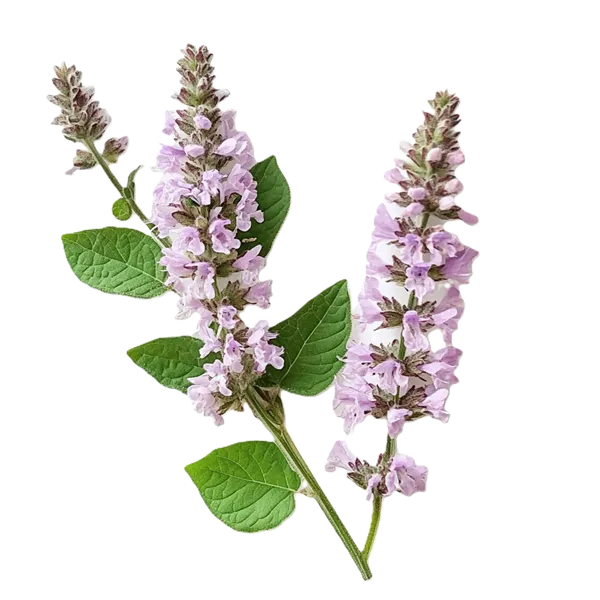
Givenchy Bergamot Essence from Calabria, Fresh Ginger Essence from Madagascar Orange Blossom Absolute from Tunisia, Sambac Jasmine Absolute from India, Tuberose Absolute from India Patchouli Essence from Indonesia, Vetiver Essence from Haiti
Fragrantica Bergamot, Pear Orange Blossom, Jasmine Sambac, Tuberose Ambroxan, Patchouli, Vanilla, Vetiver
Parfumo Calabrian bergamot, Madagascan ginger Tunisian orange blossom absolute, Indian jasmine sambac absolute, Indian tuberose absolute Indonesian patchouli, Haitian vetiver

Fragrance Family

Source Family Accords
Givenchy Floral, Woody White flower, dark woody accord*
Fragrantica Oriental Floral White Floral, Tuberose, Sweet, Citrus, Woody, Patchouli, Vanilla, Fruity, Animalic
Parfumo Floral, Sweet Floral, Sweet, Fruity, Creamy, Powdery, Woody, Synthetic
Using the French Society of Perfumers (SFP) standard as a reference, L'Interdit fits primarily into the Floral Woody family. The sustained presence of orange blossom, jasmine, and tuberose rests on a base of patchouli and vetiver, while bergamot contributes a brief citrus accent in the opening.

The pronounced fruity character noted across several sources, especially given the presence of pear and other fruity nuances, also places it close to the Floral Fruity subfamily. Both readings are compatible and reflect different facets of the fragrance rather than mutually exclusive classifications.

Scent Profile

Top Notes

~5–10 minutes

L'Interdit opens with a citrus spark crossed by a touch of warm spice, and beneath that freshness, a fruity sweetness reminiscent of ripe fruit — even bubblegum — surfaces almost right away. It's a brief but characterful entrance, before the flowers take over.

Givenchy's official notes reduce this opening to two ingredients: bergamot and fresh ginger. Bergamot delivers the initial citrus flash, bright and slightly bitter; ginger adds a warm spice that never quite tips into heat. It's a contrast of temperature rather than intensity, coolness and warmth coexisting for a few minutes before giving way to the heart.

What actually comes through on skin strays quite a bit from that official pairing, and unevenly so. Pear is, by a wide margin, the note most consistently recognized by those who try the fragrance — both in specialized reviews and in the broader consensus of fragrance communities — far ahead of bergamot.

Ginger, on the other hand, is barely mentioned at all: across a large volume of user opinions, almost no one identifies it spontaneously, which suggests it dissolves into the skin faster and with less force than its place on the official list would imply. Several sources also add a cherry nuance, reinforcing an opening far more candied than what the brand declares.

That excess sweetness has an explanation that goes beyond personal taste. Matvey Yudov, writing for Fragrantica News, traces it to methyl anthranilate, a compound shared by both orange blossom and tuberose in the heart that projects forward into the opening, producing that ripe-fruit impression from the very first seconds — even though no official pyramid lists it as a note.

This would explain why a considerable share of the audience associates the opening with grape candy or soda, and even root beer, though grape doesn't appear on any official pyramid either.

The sweet hit doesn't last long. Bergamot and ginger retreat quickly, and by around the five-minute mark, they've already yielded the spotlight to the first white flowers of the heart.

Independent Reviews:

  • Thomas Dunckley, writing for The Candy Perfume Boy, reads this opening as strawberry bubblegum — but an elevated, transparent, weightless version of it, closer to a luxury confection than anything cheap or cloying.
  • Jasmine, of The Happy Sloths, opens her review describing a burst of sour cherry and juicy pear before the white floral heart takes over.
  • Despina Veneti notes in Cafleurebon that the buildup of candied cherry, pear, caramel, and vanilla collides with the freshness of bergamot, to the point that she barely detects the dark base the brand promises.
  • Angélina, of Ambiance et Fragrance, finds the opening too syrupy for her taste, comparing it to the spirit — not the scent — of Angel by Thierry Mugler, which is why she prefers to save the perfume for winter.
  • Best Men's Colognes qualifies that pear, bergamot, and ginger fade quickly, adding a curious detail: on their skin, the patchouli from the base makes itself known early, even while the opening is still present.
  • ¿Qué olor tiene?, tracking the fragrance minute by minute, registers an impression of ylang-ylang around the five-minute mark — an isolated perception that doesn't appear in any other source or in the official pyramids consulted.

Parfumo Reviews:

  • Minigolf describes the opening as a break in temperature — fresh bergamot against the spiced warmth of ginger — the first of several tensions that will define the entire fragrance.
  • Basti87 confirms that pear, absent from the brand's official notes, is responsible for the opening's fruity character, describing a nuance that's slightly synthetic but juicy, accompanied by a spicy touch of ginger that never competes with the floral spotlight that follows.
  • FvSpee qualifies the widespread candied reading: to their nose, the opening is only mildly fruity and citrusy for five to ten minutes, without any trace of the bubblegum-like sweetness that other opinions insist on so heavily.
  • Chanelle, by contrast, finds that synthetic floral sweetness hard to get past, describing it as sticky and syrupy.

Fragrantica Community Voice:

The volume of opinions on Fragrantica confirms the pattern: the opening is mostly described as sweet, candied, and well-projected from the very first moment, with pear as the nearly undisputed star.

There is, however, a consistent group reporting the exact opposite on their skin: no recognizable fruit or flowers, just a block of patchouli and Ambroxan, or even an old-fashioned impression close to bar soap. It's a reminder that, beyond the dominant pattern, skin chemistry can radically alter this opening from one person to another.

Heart Notes

~10 minutes – 4 hours

After the first few minutes, L'Interdit shifts into a creamy, faintly candied bouquet of white flowers. Orange blossom, jasmine sambac, and tuberose merge into a dense, indolic accord, softened by a bubblegum-like nuance that keeps any hint of coldness at bay while the dark base starts to make itself felt.

This trio is, in fact, the only official heart composition Givenchy declares: orange blossom (Tunisian absolute), jasmine sambac (Indian absolute), and tuberose (Indian absolute) — a bouquet the maison describes as "narcotic and luminous." On this point, there's no disagreement: the brand, Fragrantica, and Parfumo align completely.

The evolution also follows a fairly clear pattern. Orange blossom and jasmine lead at first — the former slightly bitter, the latter fresh and green. Tuberose gradually gains ground until it becomes the dominant note, while jasmine loses strength and orange blossom settles into a warm, discreet undertone — a progression users frequently echo as well.

Nor does the tuberose behave like the most intense, narcotic version of this flower. It reads sweeter and juicier, recalling bubblegum or cotton candy and, for some, fruity nuances like grape or cherry. The result is a modern tuberose, lighter on its feet and only mildly indolic.

Precisely because the florals take up so much space, many critics and users agree that vetiver and patchouli take longer than expected to make themselves known, so the dark contrast promised by the campaign stays partly eclipsed for much of this phase.

Independent Reviews:

  • Thomas Dunckley, of The Candy Perfume Boy, describes the heart as a "vivacious cocktail" of tuberose, jasmine, and orange blossom, highlighting a tuberose with bubblegum facets that modernize the note.
  • Victoria, of Bois de Jasmin, describes a fruity tuberose whose creaminess is heightened by jasmine and orange blossom.
  • Carson, of Perfume Society, highlights the contrast between bright orange blossom, addictive jasmine, and creamy tuberose.
  • Despina, of Cafleurebon, feels the tuberose dominates so thoroughly that it leaves almost no room for vetiver or patchouli.
  • Angélina, of Ambiance et Fragrance, describes a luminous heart led by orange blossom, jasmine sambac, and tuberose.

Parfumo Reviews:

  • Aukai describes an evolution where orange blossom and jasmine open the heart before yielding the spotlight to tuberose.
  • Minigolf perceives the three flowers as a balanced accord, with none of them ever fully taking over.
  • pudelbonzo notes a warm orange blossom, a creamy jasmine, and a sweet tuberose supported by vetiver.
  • Basti87 considers tuberose the true star of L'Interdit, with a well-integrated bubblegum character.
  • Connie describes a very feminine, soft phase, dominated by tuberose, jasmine, and a touch of orange blossom.

General User Perceptions on Fragrantica

Most users describe this phase as a creamy, candied white floral, with a sweetness reminiscent of bubblegum or fruity candy, especially grape or cherry. They also agree that the tuberose reads far less indolic than usual, and that jasmine tends to go more unnoticed than tuberose.

Another frequent pattern is that vetiver and patchouli stay in the background for much of the heart phase, so the dark contrast promised by the brand takes a while to come through. A small group also mentions a banana nuance, though this remains a minority perception.

Base Notes

~6–24 hours

In the base, L'Interdit rests on a duo of patchouli and vetiver that brings an earthy, dry, faintly smoky character, contrasting with the floral creaminess of the heart. Depending on the skin, this base can feel warmer and more enveloping, with a soft sweetness reminiscent of vanilla and resins, or greener and more pronounced, to the point that some users compare it to freshly cut grass.

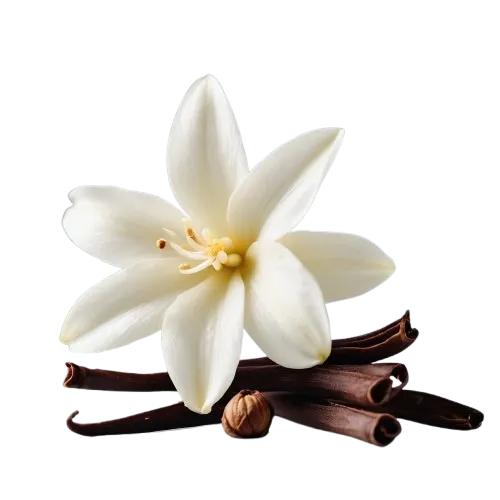
Givenchy Beauty lists only patchouli and vetiver as base notes, a composition also echoed by Parfumo and Sephora. Fragrantica, however, adds Ambroxan and vanilla, a reading backed by numerous reviews describing a sweeter, more enveloping finish than the official pyramid suggests. Some users even compare it to root beer, the American soda known for its sweet vanilla, licorice, and spice profile.

The intensity of this base also shifts from skin to skin. For some, patchouli and vetiver stay soft and let the white flowers linger through to the end; for others, they take over with a greener, earthier, drier profile. That difference explains why some describe an elegant, balanced finish, while others find it more intense or even a bit rough.

Part of that warm sensation may come down to the perfumer's signature style. Matvey Yudov, on Fragrantica, links this facet to Dominique Ropion's habitual use of vanilla, amber, heliotrope, and musk accords. Along similar lines, Victoria, of Bois de Jasmin, describes a base where patchouli gains depth through a subtle amber touch — a warm sweetness that rounds out the composition without ever reading as distinctly vanillic.

A few isolated reviews mention resinous nuances, like incense or labdanum, during the final hours. Since these don't repeat across other sources, they're best treated as one-off perceptions rather than defining traits of the composition.

Independent Reviews:

  • Jasmine, of The Happy Sloths, describes the patchouli and vetiver base notes as quite subtle on her skin, almost subordinate to the rest of the composition.
  • Despina, of Cafleurebon, states she doesn't detect the promised dark undertones of vetiver and patchouli, questioning the contrast the brand advertises.
  • Best Men's Colognes describes a drydown led by tuberose, patchouli, and vetiver, underscored by vanilla and a light touch of Ambroxan.
  • Michelle, of I Fragrance, confirms this Eau de Parfum keeps a base of patchouli and vetiver alone, unlike Le Parfum.
  • ¿Qué olor tiene?, in its detailed tracking, notes resinous incense nuances toward the end — a perception that doesn't repeat in other sources.

Parfumo Reviews:

  • pudelbonzo describes how vetiver anchors the tuberose's sweetness while patchouli contributes a smoky nuance.
  • Aukai perceives a soft, sweet patchouli, and wishes for greater intensity from both patchouli and vetiver.
  • Connie describes the opposite effect, with a base that feels too green and earthy.
  • Minigolf highlights how patchouli and vetiver add depth to the floral accord.
  • Basti87 notes a dark patchouli backed by a vanilla base.

General User Perceptions on Fragrantica

Most users agree in describing a base where patchouli and vetiver combine with a warm sweetness reminiscent of vanilla, resins, or amber. Ambroxan also comes up frequently, contributing a clean, mineral facet for some and a more synthetic one for others.

Opinions split again over the intensity of the base: some feel it ends up dominating the composition and eclipsing the white flowers, while others find it more discreet and balanced. A smaller group perceives it as having a classic or soapy air, as opposed to those who highlight its modern, elegant character.

Cabecera

Performance

Longevity | Projection | Sillage
How Long Does L'Interdit Eau de Parfum Last?

This fragrance follows a fairly consistent pattern: it opens with an intense presence, makes itself known throughout the first few hours, and gradually settles into a closer-to-skin trail that lingers for quite a while.

Longevity

Longevity is overwhelmingly perceived as long lasting. Both Fragrantica and Parfumo show broad consensus on its solid performance.

  • Longevity Scale: Very Weak, Weak, Moderate, Long Lasting, Very Long Lasting.

It's common to find users who still notice it at the end of the day and even catch the scent on clothing or hair the next morning — a pattern that supports the idea of a fragrance with strong persistence.

Specific Experiences:

  • Best Men's Colognes estimates 8 to 9.5 hours on skin, with the possibility of hitting the 10-hour mark in some cases.
  • Basti87, on Parfumo, doesn't give an exact figure but claims the fragrance "easily reaches double digits," holding a solid presence for much of the day.
  • The blog ¿Qué olor tiene? tracks the fragrance's evolution hour by hour and still detects traces after 24 hours.
  • Onur Çetin, on his blog, gives it top marks for longevity and recommends four to five sprays for a balanced result.

Not every experience lines up. Sophie King, in her video review, notes that longevity fell short of what she expected. Even so, opinions like this remain a minority against the broader consensus.

Sillage

Sillage opens with a pronounced (Strong) presence, and as the hours pass, it settles into something more moderate without ever fully disappearing.

  • Sillage Scale: Intimate, Moderate, Strong, Enormous

Moderate application is recommended, since one or two sprays are usually enough, and overdoing it can feel overwhelming during the first few hours.

Occasions to Wear It

Time of Day

Night wear gets a slight edge, though the gap with daytime use is minimal. Its versatility allows it to work across different contexts, from everyday wear to more special occasions.

Specialized reviews agree on this adaptability, highlighting its ability to maintain an elegant, eye-catching presence without being tied to a single time of day.

On Fragrantica, many users wear it daily, while others save it for dates, events, or nights out, feeling its intensity can stand out too much in certain work settings.

Season

Fall is the favorite season for most users, closely followed by winter and, to a lesser extent, spring. Summer gets less support, which is common for a fragrance with such a floral, sweet, enveloping profile.

Opinions agree that cooler temperatures favor its balance, while heat can make it feel more intense or heavy. Angélina, of Ambiance et Fragrance, shares this view and recommends saving it for winter.

Context and Lifestyle

L'Interdit Eau de Parfum fits especially well into:

  • Daily routines and office settings, as long as it's applied in moderation.
  • Casual outings and informal get-togethers.
  • Dinners and gatherings in quiet settings.
  • Semi-formal events or dates.
  • Nights out and celebrations.

Its versatility means it works at the office just as well as at dinners, celebrations, or nights out. With a moderate application, it adapts to professional settings, while a heavier hand brings out its elegant, intense character for special occasions.
Cabecera

Creation

Perfumer | Philosophy | Composition

How L'Interdit Was Created

This fragrance's story begins long before 2018. It all traces back to the friendship between Hubert de Givenchy, the French designer who founded the fashion house bearing his name, and Audrey Hepburn, the actress who became his muse and the reason behind his very first fragrance.

Givenchy commissioned a perfume just for her — a personal gesture he later chose to share with the world.

Interesting Facts:

Not everyone agrees on the exact year. Most accounts cite 1957 for both the creation and the launch, though some more detailed retellings point to two separate moments: the formula was reportedly composed privately in 1954 and only went on sale in 1957. What no one disputes is the authorship: perfumer Francis Fabron.

The story behind the name is practically a founding myth of the house. When Givenchy asked Hepburn if he could sell the perfume to the public, she's said to have replied, "But I forbid you!" — and that's how the name L'Interdit was born. With that refusal turned into a selling point, Audrey Hepburn ended up becoming the first movie star to headline a perfume's advertising campaign.

Since then, L'Interdit has never stopped reinventing itself, though its history of reformulations remains a bit muddled even for those who follow perfumery closely. Here's how the timeline breaks down:

  • 1993: known as "L'Interdit 2," with a powdery feel and a more pronounced strawberry note.
  • 2002, 2003, or 2005: neither the year nor the team behind it is entirely clear, depending on which source you check. In any case, it was a reformulation aimed at a younger audience.
  • 2007: relaunched within the Les Parfums Mythiques collection, with a formula closer to the spirit of the 1957 original.

The 2018 Version: Starting From Scratch

Under the concept of the "frisson de l'interdit" ("the thrill of the forbidden"), Givenchy set out to create a fragrance meant as an invitation to be bold and discover oneself, built on the contrast between a luminous bouquet of white flowers and a dark, woody base.

Hubert de Givenchy passed away in March 2018, months before the fragrance reached shelves, and L'Interdit ended up being his final project with the house. His signature was printed on every box of the perfume, a detail that makes this version more than just a routine commercial update.

The Perfumers

This new formula bears the signature of a trio: Dominique Ropion, Anne Flipo, and Fanny Bal.

It wasn't the first time Ropion and Flipo had worked together; they had already co-signed hits like Lancôme's La Vie Est Belle and Paco Rabanne's Invictus.

Fanny Bal, for her part — one of Ropion's former students — brought her own experience from houses like Issey Miyake and Giorgio Armani, and was working as a junior perfumer at IFF at the time.

The Formula

One of the most curious details of the formula lies in the heart's orange blossom and tuberose combination. According to Fragrantica, this pairing emerged as a middle ground between Ropion's and Flipo's differing visions of how orange blossom should be interpreted, drawing on elements from both approaches.

Behind that blend there's also a simple chemical explanation: tuberose and orange blossom share the same molecule, and this compound is what produces that first impression of juicy strawberry with hints of cherry upon application.

Many attendees at the original launch presentation reported picking up on a grape aroma as well, another effect of that same compound.

The same article draws a comparison between this formula and another Ropion creation, And The World Is Yours by A Lab on Fire, a limited edition that sold out within days. Both share a generous use of orange blossom and that vanilla-amber-musk accord often identified as a kind of personal signature of the perfumer.

As for the ingredients, the brand's official notes detail their origin: bergamot from Calabria, fresh ginger from Madagascar, orange blossom from Tunisia, jasmine sambac from India, tuberose from India, patchouli from Indonesia, and vetiver from Haiti. The fragrance is made in France, at the Ateliers Givenchy.

Cabecera

Bottle

Design | Materials | Symbolism

Bottle Design

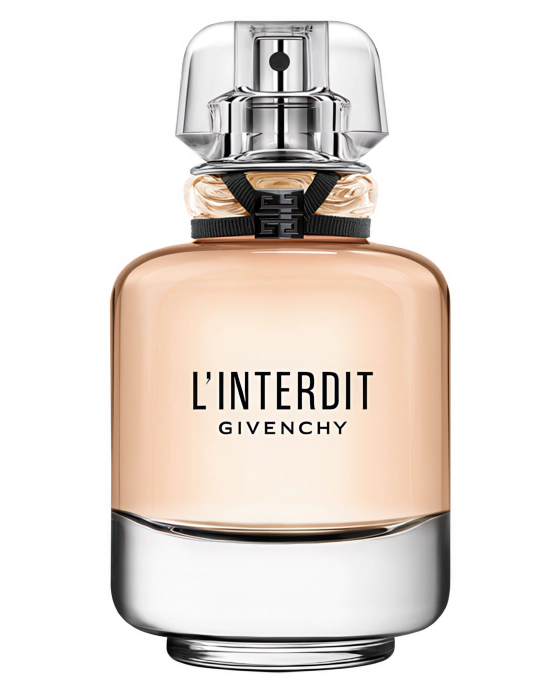
The bottle for this version of L'Interdit isn't trying to reinvent anything — it's a tribute to the 1957 original. Givenchy describes it as a "round squareness": a simple silhouette that pairs soft angles with a square base, something that feels timeless and thoroughly modern at once.

The glass stands out for its weight, thick and solid to the touch, a sensation that connects directly to the 1957 bottle, which tipped the scales at 157 grams in a solid block of crystal. The liquid reads in a warm tone, somewhere between peach and pale pink, and rests on a transparent base that contrasts with the rest of the body.

A black grosgrain ribbon wraps around the neck, fastened with a small plaque bearing Givenchy's black lacquered 4G logo. The cap, transparent with a rounded top, completes a design that leans on very few decorative elements.

Sizes and Packaging

L'Interdit Eau de Parfum has been sold in several sizes throughout its time on the market: 35ml, 50ml, and 80ml were the sizes it launched with in 2018, and the brand's current lineup expands that offering with 100ml and 125ml versions.

One of those sizes, the 100ml bottle, is refillable: it can be topped up with a 150ml refill, designed for those who already own the bottle and just need to replenish the perfume.

The box holds an unexpected detail too: behind its black-and-white exterior design lies a scarlet red interior bearing Hubert de Givenchy's signature. More than a stylistic choice, this gesture takes on symbolic weight given that it coincides with the designer's passing just months before the perfume's launch.
Cabecera

Campaign

Concept | Ambassadors | Narrative

The Face of L'Interdit: Rooney Mara

When Givenchy decided to relaunch L'Interdit in 2018, choosing the face of the campaign was no minor decision. In conversation with WWD, the house's then-creative director, Clare Waight Keller, said that as soon as she took on the role she wanted to shape a new vision of womanhood, and that among all the options available, Rooney Mara was the one who best embodied that idea.

She described Mara as someone who radiates "pure confidence, absolute grace, and eternal elegance." She added that the actress also had a dark, passionate beauty and a depth that, in her view, truly captured her vision for the house.

It's no coincidence that several reviews note a deliberate resemblance between Mara and Audrey Hepburn, the perfume's original 1957 muse: the same delicate aura, a similarly distinctive personal style, and a comparable acting sensibility. Some outlets even called her the "Audrey Hepburn of modern times."

The actress herself spoke about her connection to the perfume in a personal tone, describing it as a mix of contrasting sensations — at once sunny and dark. She said the name appealed to her because it raises the question of what is and isn't allowed, and that the jasmine-and-patchouli bouquet brought back memories of a solo trip she took across South America at seventeen.

Romain Spitzer, president of Givenchy Parfums, summed up the choice by saying that Mara's elegance and intensity were a perfect match for the new fragrance's world.

The Frisson of the Forbidden

The campaign was built around a clear concept: the "frisson de l'interdit," an invitation to break one's own rules and set out to discover oneself. Givenchy translated that idea into the tagline "franchir le pas" (take the step), meant as a call for women to dare to cross boundaries, real or imagined.

Not everyone bought into that message equally. Journalist Despina Veneti, of Cafleurebon, pointed out a gap between what the campaign promises and what actually comes through in the bottle: the marketing speaks of something subversive and underground, full of dark, mysterious notes, but to her trained nose the result turned out to be far gentler and more accessible than advertised — closer to a "walk on the safe side" than anything forbidden.

A more sympathetic reading holds that the real goal was never to recreate the 1957 perfume, but to update the house's image for a new generation — and in that sense, the campaign did accomplish what it set out to do, even if the result drifted from the original character.

The Ad: A Night in the Paris Metro

The campaign's short film was directed by Todd Haynes, with David Sims behind the camera. The story follows Rooney Mara in a black Givenchy Haute Couture lace gown, bored at a sophisticated gathering in a Parisian apartment.

At some point she decides to escape into the subway, and the atmosphere shifts completely: neon lights lead her to a closed door, behind which an entirely different party seems to be underway — worlds away from the one she left. By dawn, she reappears calm and resolute, as though something in her had been set free.

The scene takes place in the abandoned Porte des Lilas station, closed to the public, and the soundtrack pairs "Berlin By Overnight" by Max Richter with "Deceive" by Trentemøller. The whole story runs barely a minute, but it's enough to build a distinctly recognizable world.

Alongside the video, there was also a print photography campaign, with Mara in a layered black gown and bold red lips. Production credits also list models Ava McAvoy and Louise Follain, as well as actress Yun Lai, with styling by Matthieu Pabiot, hair by Tobias Sagner, and manicure by Kamel Bouri.

Cabecera

Awards

Awards | Reviews | Recognition
At the 2019 FiFi Awards France, L'Interdit won the award for Best New Women's Fragrance, presented during the 27th edition of the ceremony at the Salle Wagram in Paris before nearly 700 industry professionals and guests.

The award was accepted by Ariane Premel, head of olfactive development at Parfums Givenchy, the fragrance's three perfumers (Dominique Ropion, Anne Flipo, and Fanny Bal, of IFF), and Hélène Guillou, director of Axe Parfums at Parfums Givenchy.

That same year, the Academia del Perfume in Spain honored L'Interdit as Best Women's Fragrance in the Luxury category, at a gala held at the Auditorio Nacional in Madrid before more than 400 guests. The award was presented by jewelry designer Miriam de Ungría.

In Italy, L'Interdit was among the women's finalists at the 30th edition of the Premio Accademia del Profumo 2019, a competition that evaluates the best fragrances launched in the Italian market the previous year.

In the United States, The Fragrance Foundation named L'Interdit a finalist for Fragrance of the Year, Women's Prestige at its 2019 awards, sharing the category with Chanel Coco Mademoiselle Intense, Joy by Dior, and Giorgio Armani Sì Passione, among others.

Editorial Recognition

Cabecera

Variations

Editions | Concentrations | Flankers

Within the Line

Different Generations Under One Name

Though it keeps the name and nods to the 1957 bottle in its design, the 2018 edition strays notably from that floral aldehyde composition, built on violet, rose, tuberose, jasmine, lily of the valley, and ylang-ylang with a strawberry note, and rounded out by a spiced base of sandalwood, vetiver, incense, and tonka bean.

Victoria at Bois de Jasmin chose to judge the 2018 version as an entirely different fragrance. In her assessment, the reformulation turned it into a fruity tuberose with the spirit of a Juicy Couture scent, bearing no real olfactory relationship to whatever Audrey Hepburn might have worn.

Tom, at Perfume Posse, pushed that distance to the extreme, comparing the two versions side by side to the difference between a high-end champagne and a diet soda.

The 2018 edition wasn't the formula's first reinterpretation, either:

  • 1993 brought L'Interdit 2.
  • In 2002, Givenchy commissioned Jean Guichard and Olivier Gillotin for a fruity floral version aimed at a younger audience that, as Despina notes on Cafleurebon, alienated those familiar with the original formula and never fully connected with the younger crowd it was chasing.
  • In 2007, the edition folded into the Les Parfums Mythiques collection returned once again to the character of the original.

Within the 2018 range itself, comparisons between versions reveal a clear pattern: each flanker positions itself as either a bolder or a lighter variation on the same floral base.

  • EDP vs. Le Parfum: Michelle, of I Fragrance, compared both versions note by note. The EDP opens with bergamot and ginger; Le Parfum swaps out the bergamot for golden pear and adds mimosa to the floral heart and balsams to the base, making it richer, more intense, and longer-lasting. The reviewer concluded she preferred Le Parfum for that added depth.
  • EDP vs. Rouge and Ultime: Hulya, of Elevated Classics, describes a similar pattern. Rouge opens with blood orange and spicy ginger over the same tuberose-and-jasmine heart, while Ultime deepens that base with smoky amber and wood. Both flankers come across as bolder, less restrained takes than the original EDP.
  • EDP vs. EDT: Sophie King's video review notes that the Eau de Toilette is lighter and has less projection, with musk taking the place that vanilla holds in the EDP's base.

Echoes of Other Houses

Dominique Ropion's Signature

Matvey Yudov, at Fragrantica News, placed L'Interdit alongside Mutiny by Maison Margiela, launched the same year and also signed by Dominique Ropion. Both share a fruity opening (strawberry in one, citrus and pear in the other), a well-resolved floral heart, and a voluminous base propped up by ethyl maltol.

The same author drew another parallel with And The World Is Yours, by A Lab on Fire, also Ropion's work, with which L'Interdit shares an intense orange blossom load, the perfumer's signature Turkish rose, and his recurring vanilla, heliotrope, amber, and musk.

According to the same article, the treatment of the orange blossom and tuberose originated in a creative disagreement between the perfumers themselves, each drawing on his or her own prior work:

  • Dominique Ropion drew on Amarige, from Givenchy itself.
  • Anne Flipo drew on Le Chasse aux Papillons, from Lanvin.

Other voices placed the fragrance against more commercial references:

  • Best Men's Colognes found facets close to Gucci Bloom.
  • The blog ¿Qué olor tiene? picked up, well into its development, echoes of Dune by Dior.
  • Thomas Dunckley, of The Candy Perfume Boy, positioned it as a lighter heir to the great white tuberoses of the 1980s, borrowing their codes without replicating their dense, syrupy heaviness.

User Reviews

0.0 out of 5
0
0
0
0
0
Write a review

There are no reviews yet.

Be the first to review “L'Interdit Eau de Parfum by Givenchy | Editorial Review”

El Atlas del Perfume
Logo